(Click on either picture to see a larger version.)
Johns Hopkins University
(Updated June 2025 for the 30th anniversary of Astro-2 launch.)

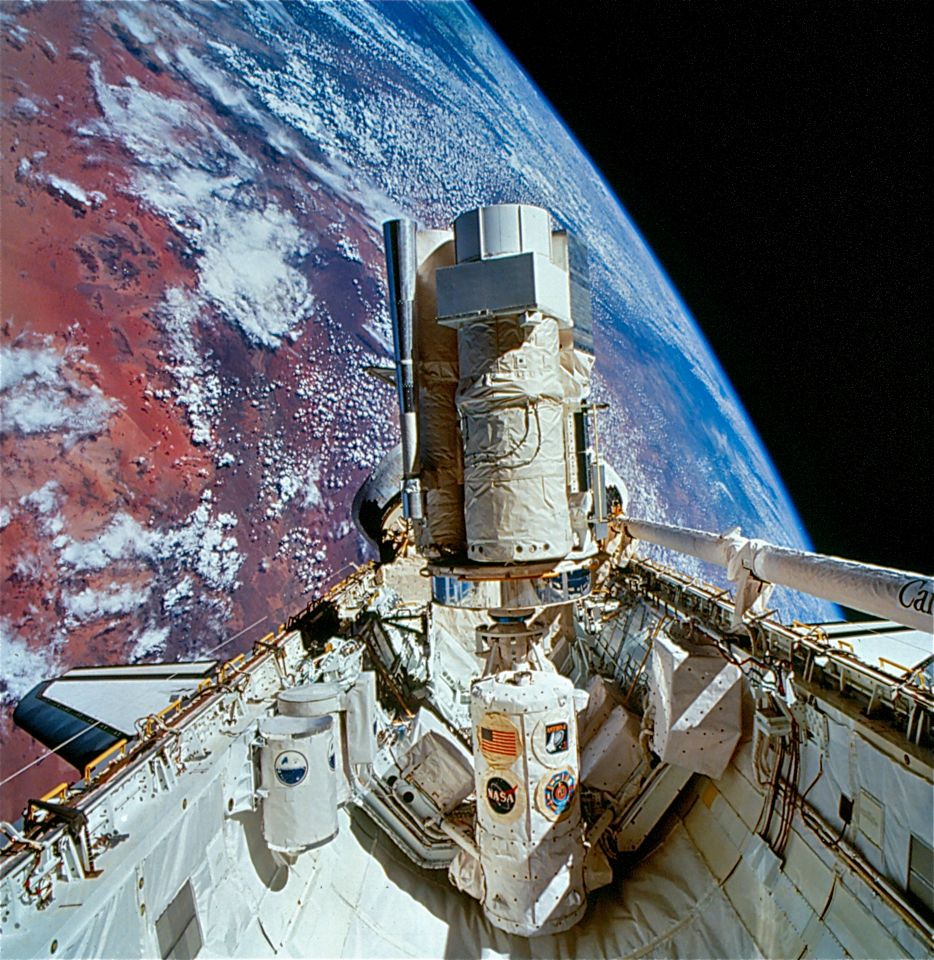
March 2, 2025, marked the 30th anniversary of the launch of the space shuttle Endeavour on a dedicated Spacelab astronomy mission known as Astro-2 (STS-67). The Astro-1 mission on Columbia (STS-35) had taken place 4-1/2 years earlier, in December 1990, making December 2, 2025, the 35th anniversary of that mission. The primary payload on both missions was the Astro Observatory, a trio of aligned ultraviolet telescopes attached to the European Spacelab hardware called the Instrument Pointing System (IPS) that turned the shuttle into a high-flying astronomical observatory. The Astro-1 mission also included a Broadband X-ray Telescope (BBXRT) housed on a separate pointing platform from the ultraviolet telescopes.
This description concentrates mainly on the wildly successful Astro-2
mission. This 16-1/2 day mission, lengthened a day by bad weather at
the landing site, was the longest shuttle mission to that time, and
held that mark until July 1996 when a medical research flight stayed in
orbit just seven hours longer! The long mission duration allowed the
telescopes to observe over 250 astronomical sources in the near and
far ultraviolet portion of the electromagnetic spectrum, wavelengths
that don't get through the earth's atmosphere.
(Click on either picture to see a larger version.)
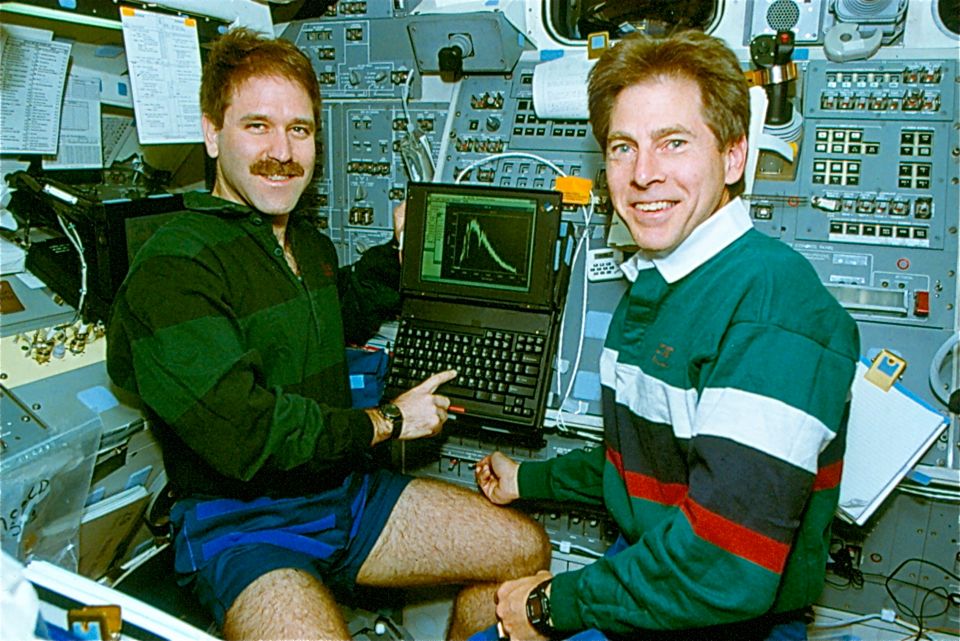
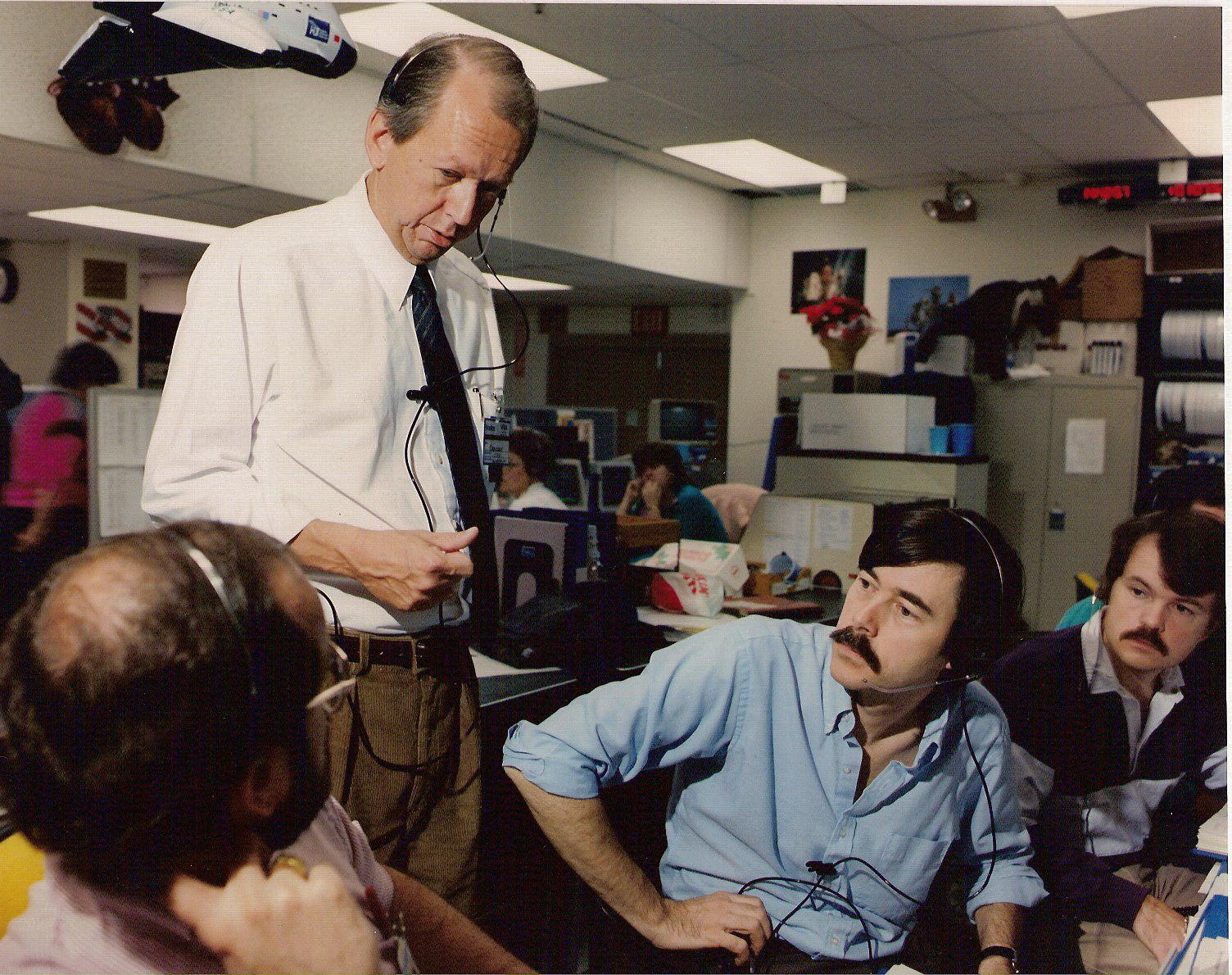
The ultraviolet telescope package was operated around the clock by two teams of astronauts who worked back-to-back 12 hour shifts. Primary control was by the crew directly from the Aft flight deck of the shuttle, with a large contingent of scientists and NASA personnel supporting their activities from the Spacelab Mission Operations Control Center at NASA's Marshall Space Flight Center in Huntsville, Alabama. Roughly twice per 90-minute orbit the shuttle was maneuvered to point the telescopes at a new object for observation.
The instruments making up the payload included an imager and two spectrographs, each of which had some characteristic that made them unique. The Ultraviolet Imaging Telescope (UIT) was designed and built at NASA's Goddard Space Flight Center in Greenbelt, Maryland. This 0.4 meter telescope with a UV-sensitive image intensifier carried 2-1000 frame cassettes of 70mm IIa-O astronomical film and was used to image 40 arcminute circular fields of view with about 2 arcsecond resolution. While this resolution is far below that achievable with the Hubble Space Telescope, each image covered an area over 250 times larger than that of the Wide Field Planetary Camera-2. Hence, UIT was able to survey the UV populations of entire galaxies or star clusters in individual pointings. The films exposed on orbit were returned to earth at the end of the mission, where they were developed and carefully digitized for analysis and comparison with optical imagery.
The Wisconsin Ultraviolet Photo-Polarimeter Experiment (WUPPE) included a 0.5 meter telescope and a special ultraviolet spectrograph that could measure the polarization of ultraviolet light across the 1400 - 3200 Angstrom range. WUPPE was developed by the Space Astronomy Laboratory of the University of Wisconsin, Madison. While some instruments on Hubble can nominally measure polarization, WUPPE specializes in bright stars and extended nebulas that are difficult or impossible targets for Hubble.
The third telescope in the package was the Hopkins Ultraviolet Telescope (HUT). As its name suggests, HUT was produced by the Johns Hopkins University in Baltimore, Maryland, and the University's Applied Physics Laboratory in Laurel, Maryland. This 0.9 meter telescope, the largest of the three, was designed to perform moderate resolution spectroscopy in the 850 - 1850 Angstrom region of the far-UV. The spectrographs on Hubble cut off sharply at wavelengths just below 1200 Angstroms. HUT overlapped with Hubble, but accessed shorter wavelengths, a spectral region that is chocked full of important astronomical information.
In addition to the three UV telescopes, the Broad Band X-ray Telescope (BBXRT), an X-ray telescope was carried along on Astro-1 and was controlled separately by a team at NASA Goddard Space Flight Center. BBXRT was mounted on a separate pointing system in the cargo bay and hence could point at the same target as the UV telescopes or could offset to another target up to 40 degrees away.
The telescopes that comprise the Astro Observatory were selected by NASA for development in 1978, three years before the space shuttle even flew! Prototypes of each telescope had flown on sub-orbital sounding rockets, but such flights only returned about five minutes of data from roughly six months of effort and preparation. The idea of the "Astro Observatory" was to develop a relatively inexpensive package of telescopes that could fly multiple times on the shuttle for a week or two each time. The Astro telescopes were scheduled to fly in March 1986 to observe comet Halley on its way out of the inner solar system, but the Challenger accident in late-January 1986 halted all shuttle flights for 2-1/2 years.
(Click on picture to see a larger version.)
After a series of frustrating delays, the payload finally flew aboard the eight-day Astro-1 mission (STS-35) in December 1990. The operational phase of Astro-1 was beset by a number of technical problems that were widely reported. In particular, the Spacelab Instrument Pointing System (IPS) had difficulty locking onto guide stars properly, which affected not only the quantity but the quality of the data gathered. However, the largely untold story is that most of these problems were overcome, and Astro-1 was a successful mission, setting the stage for Astro-2. Over 120 scientific papers were published based on Astro-1 observations, making it one of the most impactful science missions ever flown on the shuttle. But in many ways, Astro-2 was even more successful, with more observing time and many fewer operational problems.
(Click here for a brief summary of HUT Achievements from Astro-1.)
At the time of the Astro-1 flight, pressure on the shuttle launch schedule was so large that no additional flights of the telescopes were planned. However, as some payloads were switched to expendable launchers and as results from Astro-1 started coming out, NASA reconsidered and the Astro-2 mission was born!
The launch was scheduled for early 1995, which provided ample time to understand the problems with the pointing system and streamline the observation planning procedures based on the Astro-1 experience. One of the telescopes (HUT) was substantially improved with new optical coatings that enhanced its performance by more than a factor of two. In addition, NASA selected 10 Guest Investigators from the astronomical community to use the telescopes during Astro-2 along with the scientists from the instrument teams. Finally, NASA scheduled the mission on Endeavour, which was outfitted with a special energy kit that would allow the shuttle to remain on orbit for over two weeks.
As the launch date for Astro-2 approached, hopes were running high. But for those of us involved in Astro-1, the spectre of launch delays and operational problems could not be entirely forgotten.

(Click on the picture to see a larger version.)
Endeavour was scheduled to launch at 1:37 a.m. EST on March 2, 1995. In the couple of days prior to launch, the weather at Cape Canaveral was overcast. The prediction for launch day was so bad that there was serious discussion about whether to "tank up" or just delay the mission by a couple of days and hope for better weather. In the end, they decided to go for it as scheduled. It was the right decision. In the hour prior to launch, the clouds dissipated "dramatically" (to quote one eyewitness account), and the launch occurred only a minute later than nominally scheduled! The eight minute ride to orbit was picture perfect, and the orbit achieved was exactly as planned. We were off to a good start!
The first 30 hours on orbit were devoted to activation and checkout activities. In contrast, when a major ground-based observatory comes on line, this phase can take six months or more. We gave ourselves a little over one day! Although some minor glitches occurred, this phase went quite smoothly. A few growing pains with the pointing system extended over the first several days, but they were worked out as we were making observations, causing a relatively small impact. Our carefully revamped procedures for replanning observations was working effectively. Compared with our Astro-1 experience, this was heaven!
Another remarkable aspect of Astro-2 was that even nature cooperated. As one example, three bright galactic novas had popped off in the month and a half prior to launch. Hence, not only did we have three novas to observe, but they were at different phases of development at the time of our observations. Likewise, we intended to make repeated observations of the active Seyfert galaxy NGC 4151 to search for variability that would provide clues to the structure within light days of the suspected black hole in the center. During our first observation of this galaxy we were surprised to find that it was five times brighter than it had been during Astro-1! Even observations of planets or other objects that had to be observed at certain phases (or in conjunction with other spacecraft such as Hubble, the Extreme Ultraviolet Explorer, or the ASCA satellites) came off without a hitch. We were truly charmed!
For over two weeks the astronauts and ground controllers worked around the clock scheduling observations, maneuvering the shuttle, acquiring new targets, and observing with the telescopes. Some 385 shuttle maneuvers were made to point the telescopes at over 250 unique targets during Astro-2. And with more stable pointing, the quality of the observations was outstanding as well. I remember as late as 10 to 12 days into the mission having nagging thoughts, wondering when the "bomb would drop on us" so to speak, but it never happened. Astro-2 was a mission made in heaven.
One of the strengths of the Astro Observatory was its ability to tackle an extremely wide range of scientific problems. Over 50 specific science programs had been proposed by the investigators, observing everything from planets to quasars and representative targets of just about everything in between!
With the telescopes operating specifically in the ultraviolet (which gets blocked by earth's atmosphere), the Astro telescopes returned a treasure trove of unique information about hot stars, cataclysmic binary stars, nebulae and supernova remnants, and even the interstellar gas and dust in our own Galaxy and the Magellanic Clouds. Beyond the Milky Way, the hot stellar populations in many kinds of galaxies were probed, as well as the processes occurring in and around so-called active galaxy nuclei, thought to be the sites of massive black holes. Even the enigmatic quasars, which may be more distant and energetic counterparts of active galaxies, were the targets of observation.
It is impossible to describe the full breadth of results coming out of Astro-2 in the context of this short description. However, one high priority program, the measurement of the so-called intergalactic medium, will be mentioned specifically because of its importance to cosmology.
The presence of a diffuse intergalactic medium (or IGM) is a basic prediction of the Big Bang theory. Not all of the normal (or so-called "baryonic") matter created in the Big Bang should have coalesced into galaxies and stars; some should have been left in intergalactic space. This IGM should give itself away by causing absorption at high redshifts in the spectra of distant quasars. While discrete absorption lines of hydrogen are seen in great numbers in quasar spectra (the so-called "Lyman alpha forest"), these absorptions arise from discrete clouds of material along the line of sight. No evidence of a truly diffuse component has ever been seen from hydrogen. Hydrogen is the most abundant element in the Universe, so the reason it is not seen may be due to the fact that it is completely ionized (and hence cannot absorb light).
Dr. Arthur Davidsen from Johns Hopkins (the Principal Investigator of the HUT instrument) and colleagues used HUT to obtain the far-UV spectrum of a distant quasar known as HS 1700+64. The redshift of this quasar is such that absorption from ionized helium (the next most abundant element, and harder to ionize than hydrogen) could be sought. This spectrum not only detected this diffuse IGM unequivocally from its helium absorption, but permitted a measurement of how much total material is present in this component (with certain assumptions). The answer is that there could easily be three to five times as much material in this extremely dilute component of the universe as is present in ALL of the galaxies and stars! Incidentally, the desire to make this particular measurement was a primary reason Dr. Davidsen proposed HUT to NASA in 1978. Without the Astro-2 mission, this observation would have never been accomplished. Largely because of this important result, in 2001 the Smithsonian National Air and Space Museum placed the HUT telescope on display in their Exploring the Universe gallery in the main downtown Washington museum.
(For a helpful diagram and somewhat more technical description of this result, please CLICK HERE.)
As of 30 years after launch, there are over 170 Astro-2 related scientific papers published in refereed astronomy journals by the science teams. In 2013, the HUT data were reprocessed and archived for general use by astronomers, through the Mikulski Archive for Space Telescopes, joining WUPPE and UIT data already in that archive. The original HUT Web site materials, reprocessed data, and other historical materials are available HERE.
Even now, after several decades, the marvelous data sets produced by the Astro Spacelab missions continue to bear much scientific fruit as they are often used in conjunction with data on the same targets from other NASA missions.
William Blair is a Research Professor at Johns Hopkins University and was Deputy Project Scientist for Mission Planning and Operations on the HUT team for Astro-2. His involvement with the Astro missions dates back to his arrival at Hopkins in 1984. He was also Chief of Observatory Operations for the Far Ultraviolet Spectroscopic Explorer satellite project from 2000 - 2009, also based at Hopkins. Dr. Blair's main research interests are in supernova remnants and the interstellar medium of galaxies.
Click here and view the Gallery link in the left menu for more pictures from the Astro-1 and Astro-2 missions.
Last updated: June 2026.
Bill Blair ([email protected])